Where do manga come from? A history in five eras
From painted scrolls and Hokusai’s sketchbooks to weekly magazines and digital reading: how manga became the most-read comics in the world.
Manga is now the most-read form of comics in the world, and France is its second market after Japan. Yet behind the volumes lined up in bookshops lies a long history, made of painted scrolls, sketchbooks, a medical student turned cartoonist, and magazines so thick that people read them standing on the train. Here is that history, in five eras.
1. Before the word: scrolls, prints and sketchbooks (12th–19th century)
Manga is often traced back to the emaki, the painted scrolls of medieval Japan that tell a story continuously as you unroll them. The most famous, the Chōjū-giga (“animal caricatures”), shows rabbits, frogs and monkeys wrestling, praying and mocking monks, with a freedom of line that still strikes today. No panels, no speech bubbles, but already the idea of an image that moves.
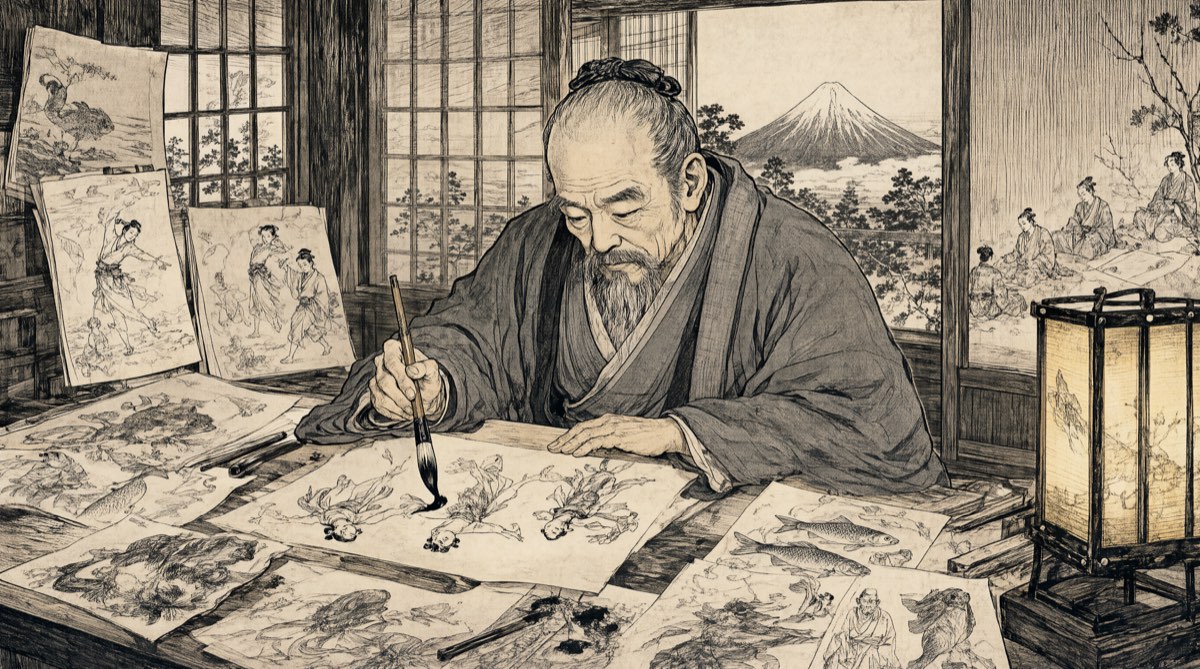
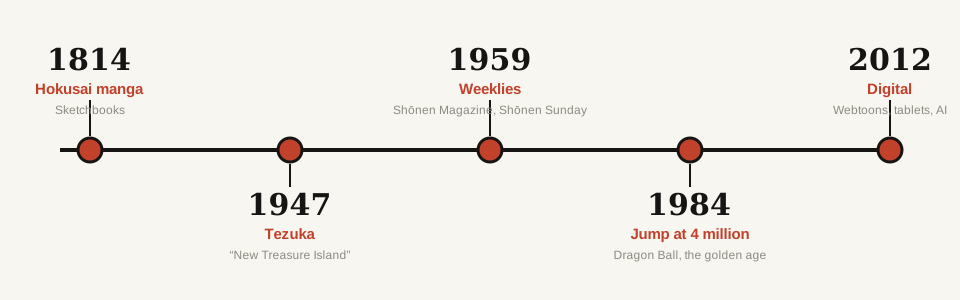
The word “manga” itself comes much later. In 1814, the painter Katsushika Hokusai, the man behind The Great Wave, published the first volume of his Hokusai manga: fifteen sketchbooks in which wrestlers, dancers, ghosts, fish and grimaces sit side by side. “Manga” translates roughly as “whimsical pictures” or “drawings as the brush goes”. They are not stories, but thousands of figures caught on the fly, which would serve as models for generations of artists.
At the same time, the woodblock print (ukiyo-e) was circulating images on a large scale, cheaply, across the whole country. The idea that an image can be reproduced, sold and collected was already there.
2. The Meiji era and the press: the first panels (1870–1930)
When Japan opened to the West, satirical papers brought in by Europeans, such as Charles Wirgman’s Japan Punch, introduced the press cartoon. Japanese artists took it up, then discovered American comic strips, their sequenced panels and their speech bubbles. Rakuten Kitazawa, often considered the first professional mangaka, was publishing multi-panel stories in a Sunday supplement as early as 1902.
In the 1920s and 1930s, children’s magazines multiplied. Norakuro, a slightly clumsy soldier dog, became manga’s first great star and sold his adventures in bound albums. The visual vocabulary settled: the panel, the bubble, the recurring character, the series that returns every month.
3. Tezuka and the post-war years: manga becomes a story (1945–1960)
In the aftermath of the war, paper was scarce and so was money. Two circuits kept manga alive: the akahon, small red-covered books sold for a few yen in the streets of Osaka, and the lending libraries, the kashihon, where you rented a volume for an evening.
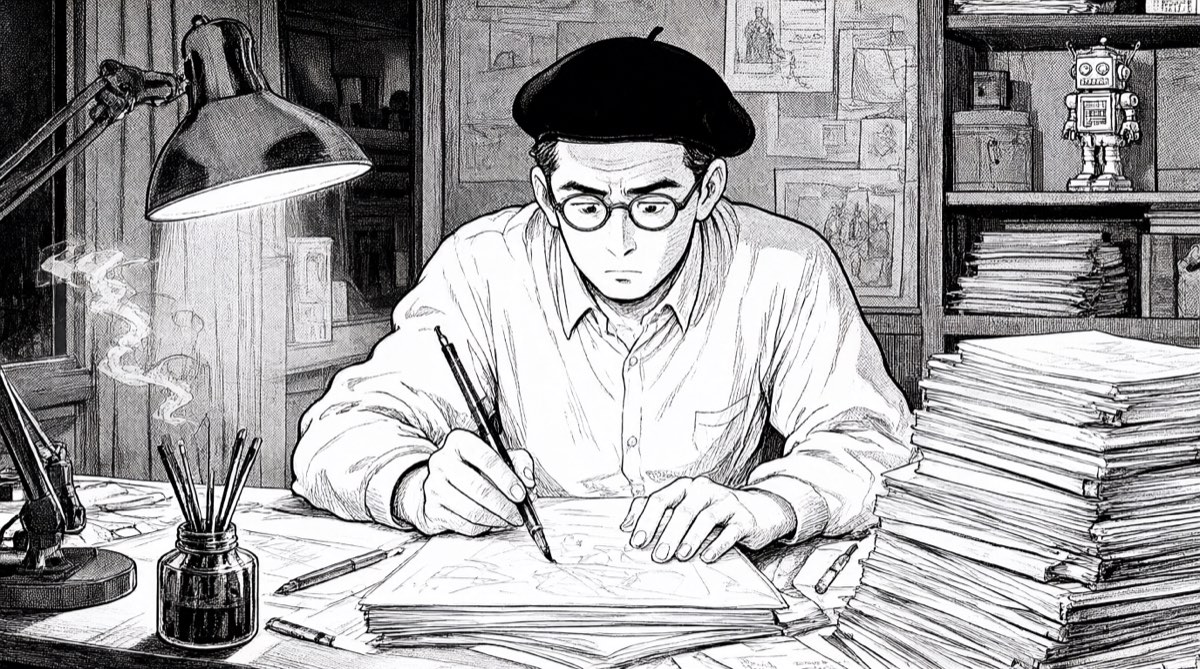
It was in an akahon that Osamu Tezuka, an eighteen-year-old medical student, published New Treasure Island in 1947. The book sold hundreds of thousands of copies and changed the grammar of manga: cinematic framing, close-ups, camera movements, wordless sequences several pages long. Tezuka went on with Astro Boy, Kimba the White Lion, Princess Knight, and with them whole genres: science fiction for children, the animal story, manga for girls. His round line and large eyes, partly inherited from American animation, became the foundation of the “manga” style as people still picture it.
The lending libraries, for their part, fed a darker and more adult current: gekiga (“dramatic pictures”), carried by Yoshihiro Tatsumi and Takao Saitō. Realistic line, violence, poverty, disillusion. Adult manga was born there, long before it had a shelf name.
4. The age of the weeklies: the industry (1959–1995)
In 1959, two publishers launched Shōnen Magazine and Shōnen Sunday in the same week: weekly magazines of several hundred pages, printed on recycled paper, each running some fifteen series at once. Shōnen Jump followed in 1968. The principle is simple and merciless: every week, readers vote for their favourite series; those that drop in the ranking are stopped.
This system manufactures the rhythm of modern manga. A mangaka produces about twenty pages a week, with assistants who draw backgrounds and lay screentones. The chapters are then gathered into bound volumes, the tankōbon, which are the real product. This is when manga segmented by readership: shōnen for boys, shōjo for girls, then seinen and josei for adults, with magazines dedicated to each. We devote a whole article to these major styles.
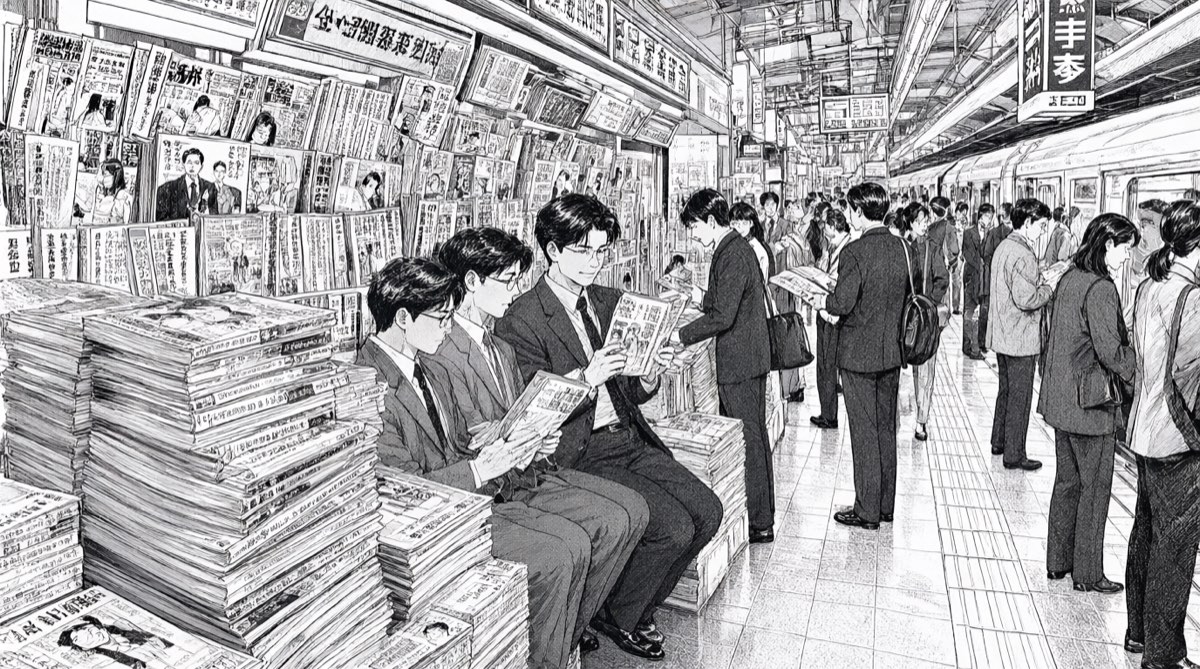
The 1980s and 1990s were the golden age. Dragon Ball, City Hunter, Saint Seiya, Slam Dunk: Shōnen Jump passed six million copies a week in 1995. At the same time, Katsuhiro Ōtomo’s Akira proved to Western readers that a manga could be a major graphic work, and the animated series drawn from these titles reached European television, preparing an audience that did not know it yet.
5. Global and digital manga (1995–today)
In France, Glénat published Akira in 1990 and Dragon Ball in 1993; sales exploded, then settled into structure in the 2000s with Naruto, One Piece, Fullmetal Alchemist. Today manga accounts for nearly one book in ten sold in France, and the country has festivals, schools and authors who draw in the Japanese style without ever having lived in Japan. The same story played out, with a few years’ delay, in the United States and the United Kingdom.
The form is moving too. Paper magazines are losing ground to reading apps, to Korean webtoons in vertical scroll, to platforms where an author publishes alone. And for a few years now, artificial intelligence tools have let someone who cannot draw obtain a full page from a text, which is precisely what Ai-Koma does. Manga has always been a matter of reproduction, rhythm and industry; each era simply changed the tool.
What to remember
- The word comes from Hokusai (1814), but manga as a story in panels dates from the post-war years and Tezuka (1947).
- The weeklies of 1959 created the industry: short chapters, reader rankings, bound volumes.
- Segmentation by readership (shōnen, shōjo, seinen, josei) describes target readers, not genres.
- Every revolution in manga is first a revolution of the tool: the carved block, the nib, the magazine, the screen, and now AI.
To continue: the 30 words of manga and the anatomy of a page.
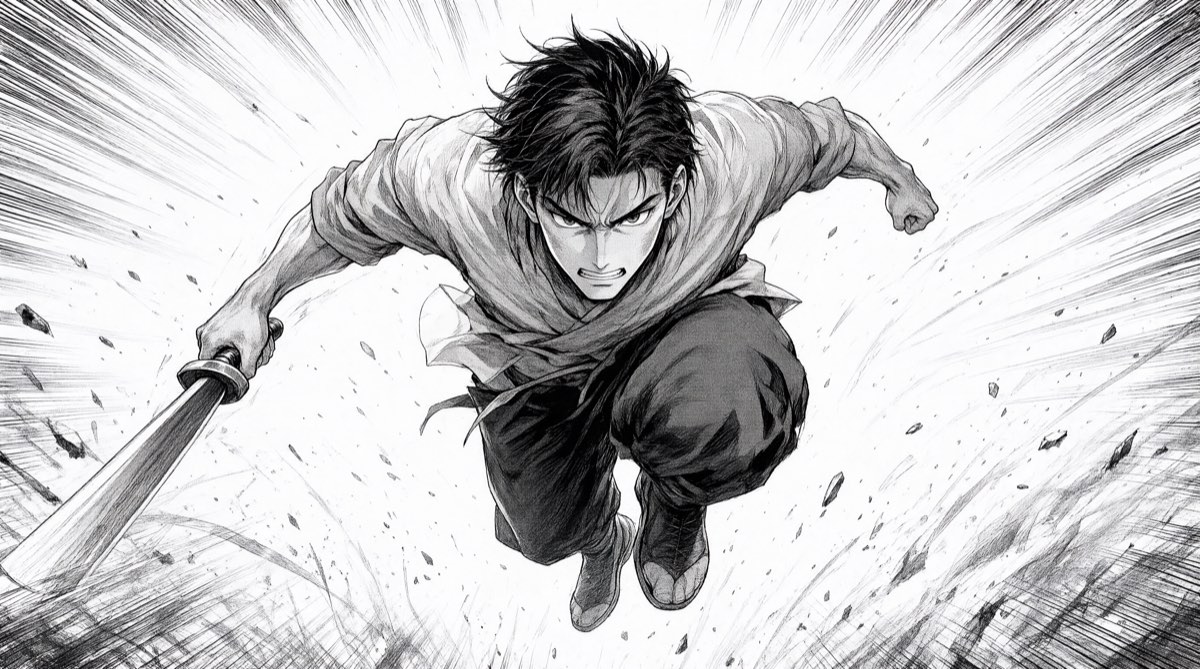
The illustrations in this article were drawn by Ai-Koma from descriptions written by the team; they depict no real person.
 How to write a manga without knowing how to draw: the five-step method
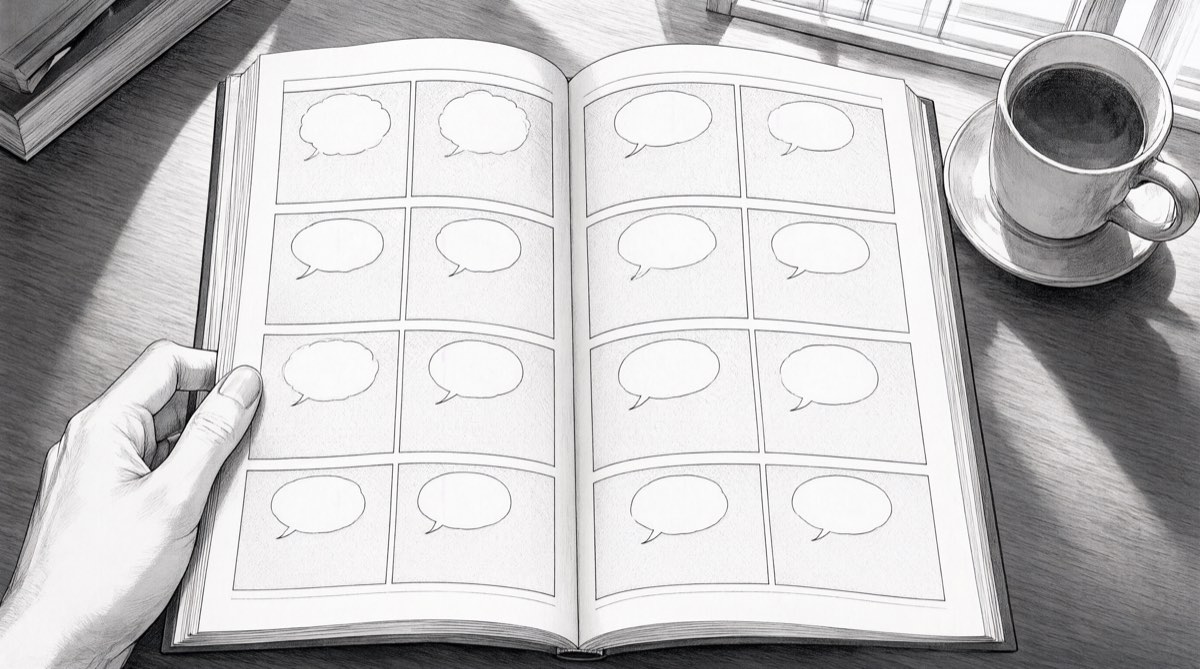 Anatomy of a manga page: panels, speech bubbles, reading direction
 Shōnen, shōjo, seinen, josei: the main manga styles and how to recognise them