Manga vocabulary: the 30 words you need to know
Mangaka, tankōbon, nekketsu, screentone, sound effect, yonkoma, isekai… An illustrated glossary to read, talk and write manga without getting it wrong.
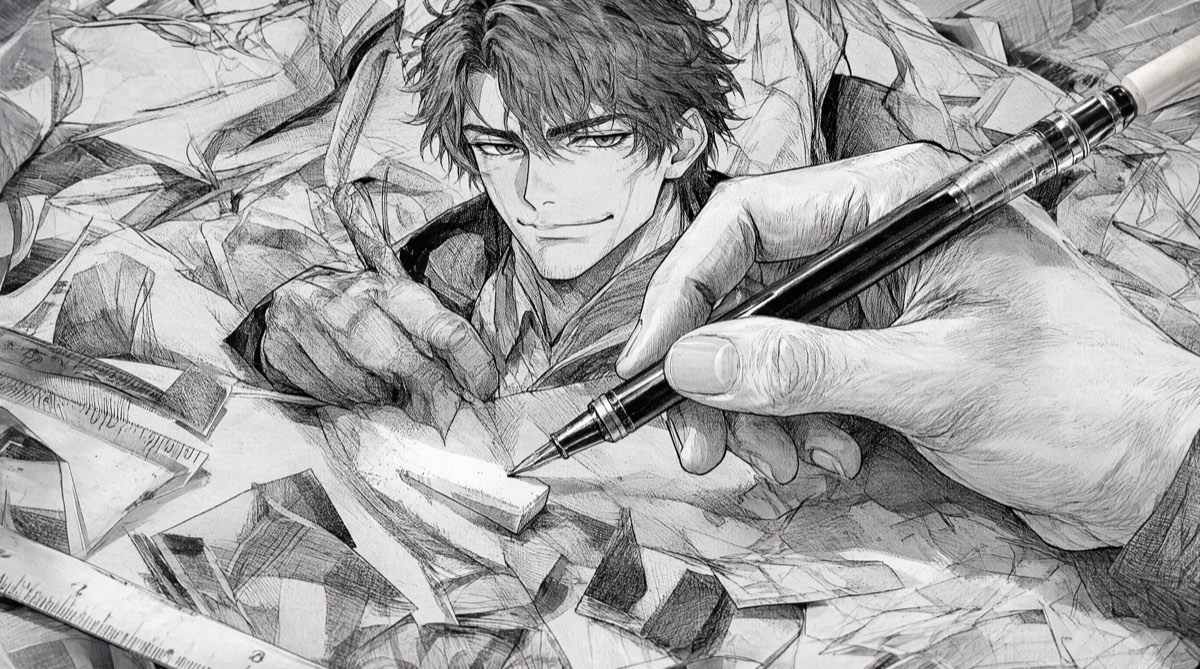
Manga has its own vocabulary, half Japanese, half studio jargon. You can read it without knowing the words, but you write it much better when you do: knowing what a caption, a screentone or a nekketsu is changes the way you describe a scene. Here are the thirty words that come up most, sorted into four families.
People and objects
- Manga
- Japanese comics, and by extension any comic that adopts their codes. The word, popularised by Hokusai in 1814, means roughly “drawings as the brush goes”. In English the plural is usually “manga” too.
- Mangaka
- The author of a manga. In Japan, a mangaka often works with assistants who draw backgrounds, lay screentones and ink crowds.
- Tankōbon
- The bound volume that collects about ten chapters first published in a magazine. It is the format sold in bookshops, the one you stack on shelves.
- Chapter
- The unit of magazine publication: about twenty pages a week for a weekly, forty to sixty for a monthly. Each chapter ends on a hook so the reader comes back.
- One-shot
- A complete story in a single chapter or volume, with no sequel planned. Often a young author’s first publication.
- Yonkoma
- The “four-panel manga”, stacked vertically like a strip: set-up, development, twist, punchline. The king of comedy formats.
- Light novel
- A short, illustrated novel, often adapted into a manga and then an anime. Many isekai come from there.
- Anime
- Japanese animation. A successful manga often becomes an anime; the reverse happens too.
- Doujinshi
- A self-published amateur work, often reusing existing characters. The breeding ground where many mangaka started.
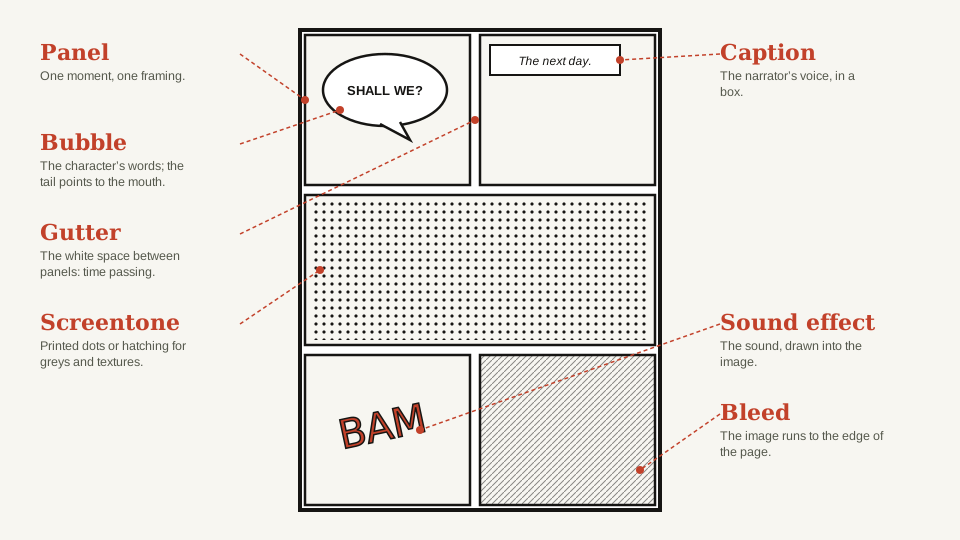
The words of the page
- Page (planche)
- A full drawn page, with all its panels. It is the artist’s unit of work, and the pricing unit at Ai-Koma: one generation, one page.
- Panel (koma)
- A frame that holds one moment. Its size and shape set the rhythm: a large panel slows down, a run of small ones speeds up.
- Gutter
- The white space between two panels. The reader imagines what happens between the two images there; that is where time passes.
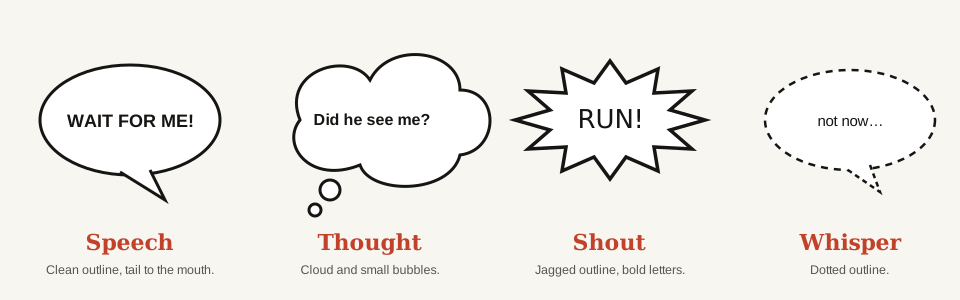
- Speech bubble (fukidashi)
- The balloon that holds the words. Its shape tells the tone: round for speech, cloudy for thought, jagged for a shout, dotted for a whisper.
- Caption
- The box that carries the narrator’s voice or a note of place and time: “The next day.”, “Tokyo, 11 pm.”
- Sound effect (giongo)
- The sound drawn into the image: DOKI (a beating heart), GOGOGO (rising tension), BAM, SHHH. Japanese even has sound effects for silence.
- Screentone
- An adhesive sheet of dots or lines, cut and stuck down to obtain greys and textures. Applied digitally today, it keeps its name and its look.
- Bleed
- An image that runs to the edge of the page, with no margin. Reserved for strong moments: an arrival, a landscape, a revelation.
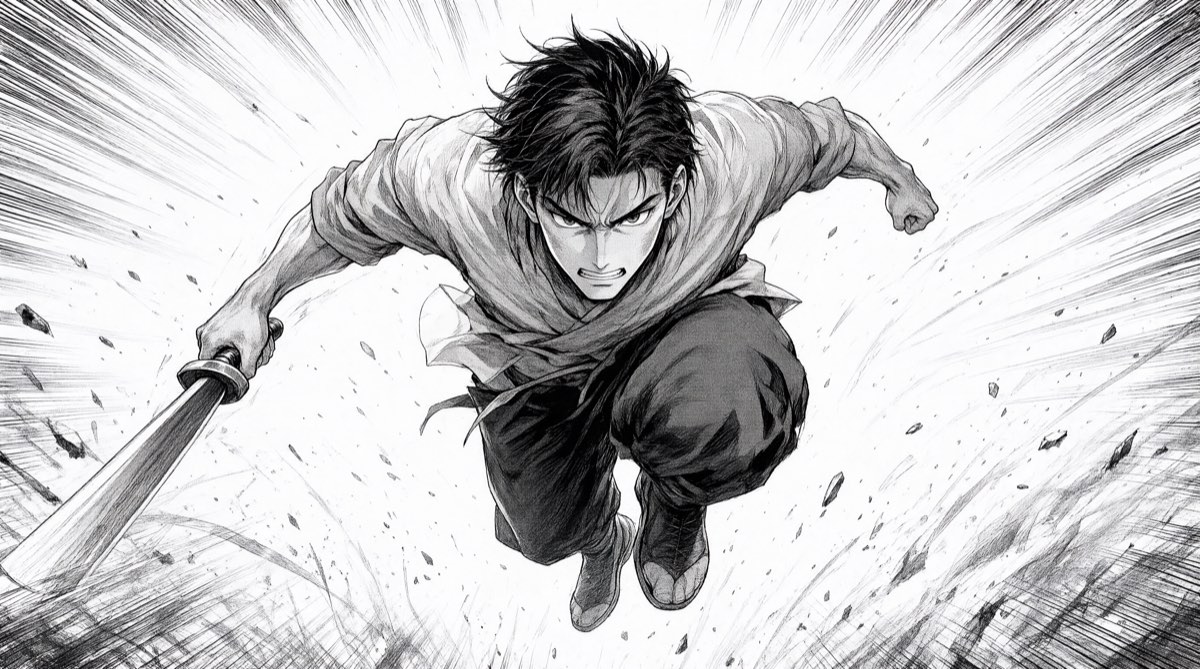
- Speed lines
- The parallel or radiating strokes that give movement and speed. In a shōnen fight, the background often disappears behind them.
- Inking
- The stage where the pencils are gone over in ink, with a nib (the famous G-pen) or a brush. Inking gives manga its sharp black and white.
Readerships and genres
- Shōnen
- Aimed at teenage boys: action, friendship, self-improvement. Dragon Ball, One Piece, Naruto. A target readership, not a genre: there are cooking shōnen and tennis shōnen.
- Shōjo
- Aimed at teenage girls: feelings, relationships, high school, often with an airier line and flowery backgrounds. Fruits Basket, Nana.
- Seinen
- For young adult men: more realism, violence, politics, darkness. Berserk, Monster, Vagabond.
- Josei
- For adult women: working life, couples, motherhood, desire, with a frankness shōjo does not have. Chihayafuru, Princess Jellyfish.
- Kodomo
- For young children. Doraemon, Pokémon.
- Nekketsu
- Literally “hot blood”: the shōnen subgenre where the hero progresses through willpower, training and friendship. The most copied formula in manga.
- Isekai
- “Another world”: the hero is transported (or reincarnated) into a fantasy or video-game universe. The most prolific genre of the 2010s.
- Slice of life
- No high-stakes plot, but everyday life, observed with tenderness or humour. Often the hardest genre to write well.
- Ecchi
- Cheeky manga: innuendo, partial nudity, awkward situations, without any sexual act shown. At Ai-Koma, this is romance level 2.
- Hentai
- Pornographic manga, explicitly for adults only. The word means “pervert” in Japanese, where people say ero-manga instead.
- Gekiga
- “Dramatic pictures”: the realistic, adult current born in the 1950s, ancestor of seinen.
Studio words
- Name (nēmu)
- The storyboard: a quick draft of every page, with the layout, the position of the bubbles and the text, before the final drawing. It is the stage the editor approves. At Ai-Koma, it is the “storyboard” you review before launching the pages.
- Layout (découpage)
- Splitting the story into pages and panels: what to show, in which order, at which size. The mangaka’s real craft, even more than drawing.
- Character sheet
- The reference drawing of each character, front and profile, with their outfit and distinctive marks, so they stay the same from page to page. Ai-Koma draws one per story.
- Reading direction
- A Japanese manga reads right to left and top to bottom, inside each panel too. The manga produced by Ai-Koma read left to right, like a Western comic.
Now you know the words. To see how they fit together on a page, read the anatomy of a page; to choose your register, the main manga styles.
The illustrations in this article were drawn by Ai-Koma from descriptions written by the team; they depict no real person.
 How to write a manga without knowing how to draw: the five-step method
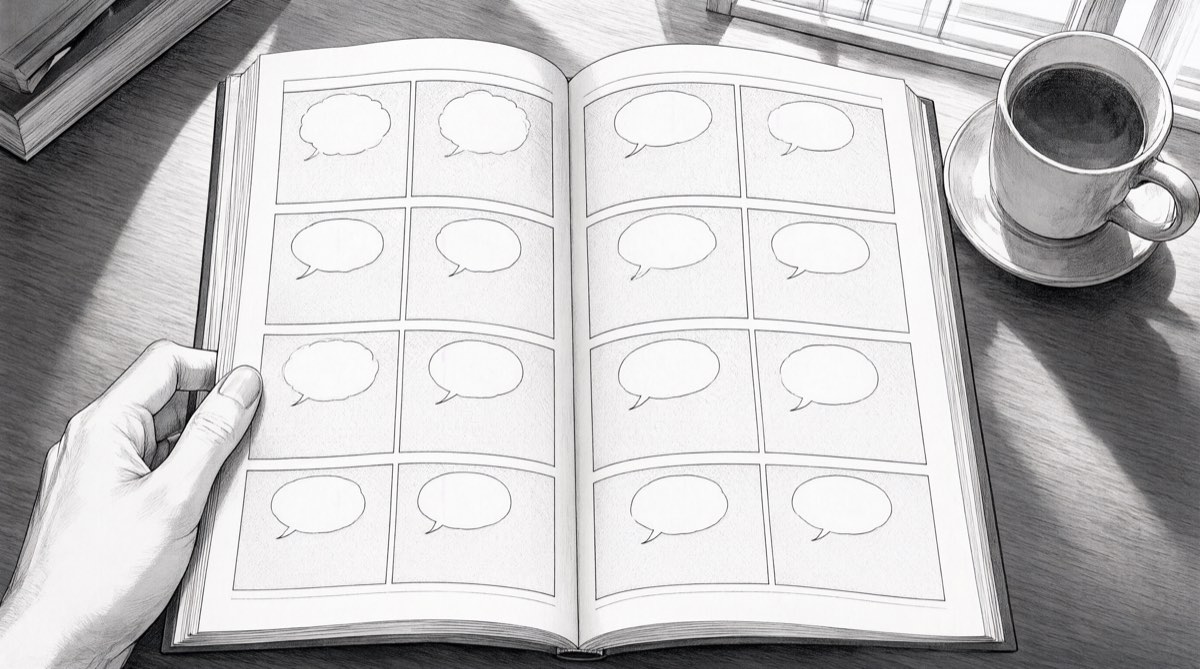 Anatomy of a manga page: panels, speech bubbles, reading direction
 Shōnen, shōjo, seinen, josei: the main manga styles and how to recognise them