How to write a manga without knowing how to draw: the five-step method
You have a story but not the pen skills? Here is how to go from three lines to a drawn chapter, speech bubbles included, with an AI-assisted studio.

Many people have had a manga story in their head for years: characters, an opening scene, an ending they can see very clearly. What stops them is the drawing. A professional mangaka takes years to master a nib, and a page takes a day. Today there is another way: write, let an AI-assisted studio draw, then review and correct. Here is the method, in five steps, as it works in Ai-Koma, and the advice that holds for any tool.
Step 1: tell it in three lines (then in ten)
A manga starts with a pitch, not a script. Three lines are enough to launch a preparation: who, where, what changes. “Two colleagues in their thirties find themselves alone at the office on a Thursday evening; a presentation to finish, a tension that is not new.” That is enough to get a four-page storyboard.
But the more you say, the more the result looks like you. The three things that pay the most:
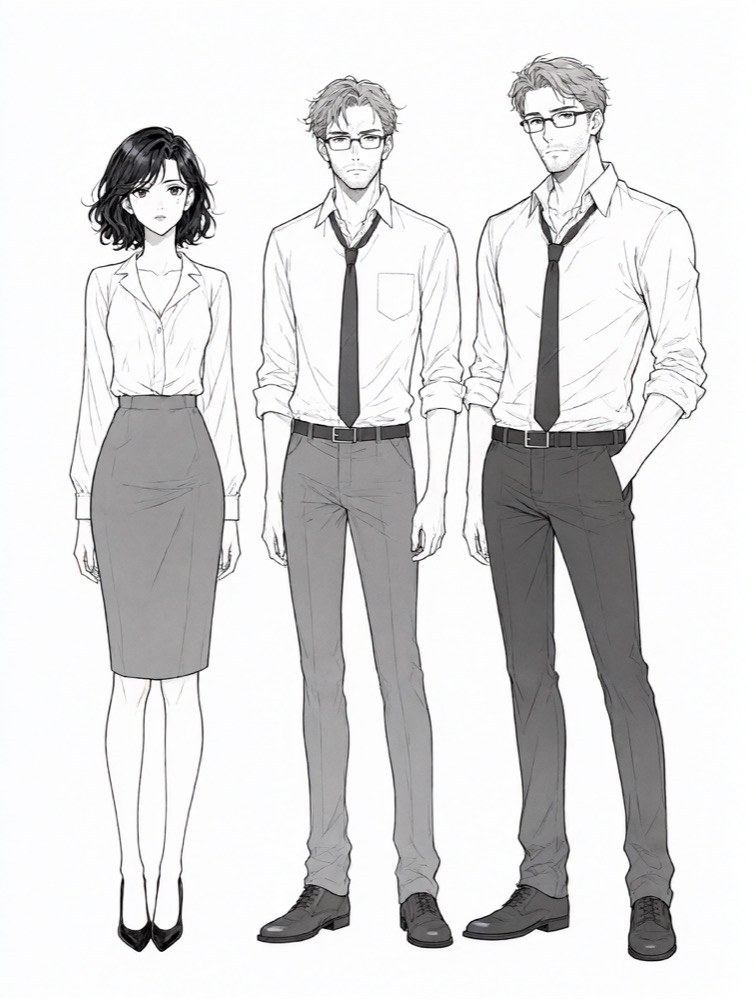
- The characters, physically. Age (adults, with us), haircut, glasses, outfit, one detail that sets them apart. These details become the character sheet, drawn once, which guarantees that each keeps their face from page to page.
- The place and the time. “A glass open-plan office at night, the city behind” gives a setting; “at the office” gives anything.
- The ending. Even if it does not arrive in this chapter, say where the story is going: the storyboard will know what to prepare.
You then choose a manga style (shōnen, shōjo, seinen, josei, horror, hentai…), a rendering (black and white or colour), a number of pages, and the content levels: romance, violence and language, set separately for text and for image, from 0 (all audiences) to 4 (explicit, reserved for verified adults). That setting is what turns the same story into a tender romance or a sensual night.
Step 2: review the storyboard, this is where it all plays out
Before drawing anything, the studio writes a storyboard: for each page, a summary, then panel by panel, a visual description, the character who speaks, their line, and possibly a caption. It is the equivalent of the name, the storyboard that mangaka submit to their editor before drawing.
Take the time to read it like an editor. The useful questions:
- Does each panel show a different moment, with a different framing? Two panels that look alike, cut one.
- Are the lines short? Ten words is good; twenty is too many for a bubble, and image models make mistakes in long texts.
- Does the strong moment of the page have the largest panel?
- Does the chapter end on something that makes you want to read the next one?
You can edit every line and every description by hand, or ask for a more explicit version if the storyboard stays too tame for the levels you chose. Nothing is drawn until you have approved it.
Step 3: draw, page by page
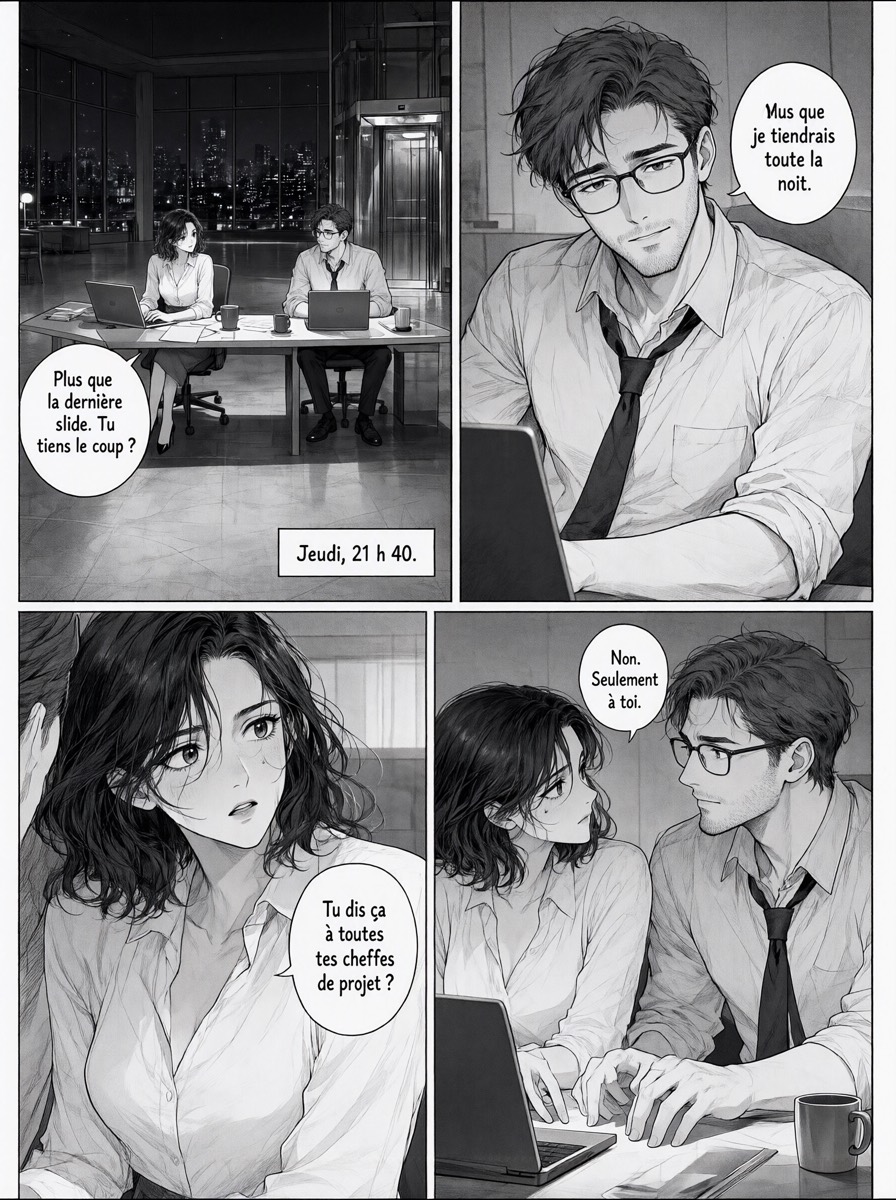
Each page is generated as a single image: the panels, the characters, the settings, the bubbles with their text, the screentones. It takes one to two minutes per page. The studio then compares the page with the storyboard: number of panels, text outside the bubbles, and, for sensitive content, a safety check that refuses anything crossing the prohibitions. A failed page is redrawn once for free; a removed page is refunded.
At this stage, reread the bubbles. Image models are improving fast, but a distorted letter or a missing accent still happens. A page is corrected in one generation, with the exact text, without changing the drawing.
Step 4: continue in chapters
A manga is not a one-shot. When you like a chapter, you ask for the next: the studio starts again from what has been told, the same characters, the same sheet, the same setting, and writes the following chapter without repeating events. This is the moment to think in arcs, like Japanese series: a problem set up, a few chapters to resolve it, a new problem appearing in the resolution.
Step 5: bind
All the chapters of a story download as one bound PDF: cover, contents, numbered chapter pages, back cover. For a more polished edition, an illustrated cover is drawn by the AI from the character sheet. The images carry a machine-readable mark that flags them as AI-generated, as European law requires.
What the method does not do for you
A tool draws; it does not write what matters for you. Three things remain entirely in your hands:
- The desire. Why this story, why these characters, what holds you. A storyboard feels it immediately.
- The rhythm. Where to cut, where to slow down, what not to show. Reread the anatomy of a page: that is the mangaka’s craft, and it is yours.
- The tone. The same event is funny, tender or terrible depending on the line. The dialogue is the best place to put your voice.
What it costs
At Ai-Koma, one credit is worth one euro cent. Preparing a chapter costs 20 credits plus 5 per page; each drawn page costs 25 credits (20 beyond the fourth). A four-page chapter therefore comes to 140 credits, i.e. €1.40 with the Découverte pack, less with the subscription. The 50 credits offered at sign-up pay exactly for the preparation and drawing of a first page: enough to judge for yourself.
To get started
Write three lines. No more, no less. Choose a style and a number of pages. Read the storyboard as if someone else had written it. Then draw one page, just one, and see what it does to watch your characters exist. The rest follows.
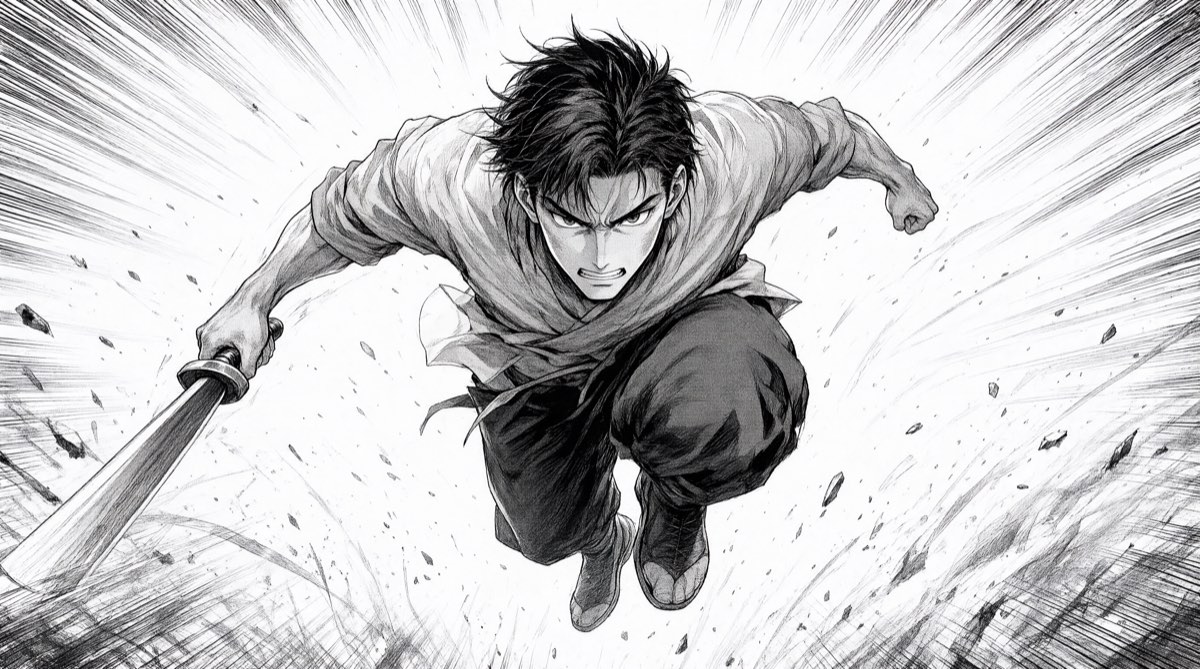
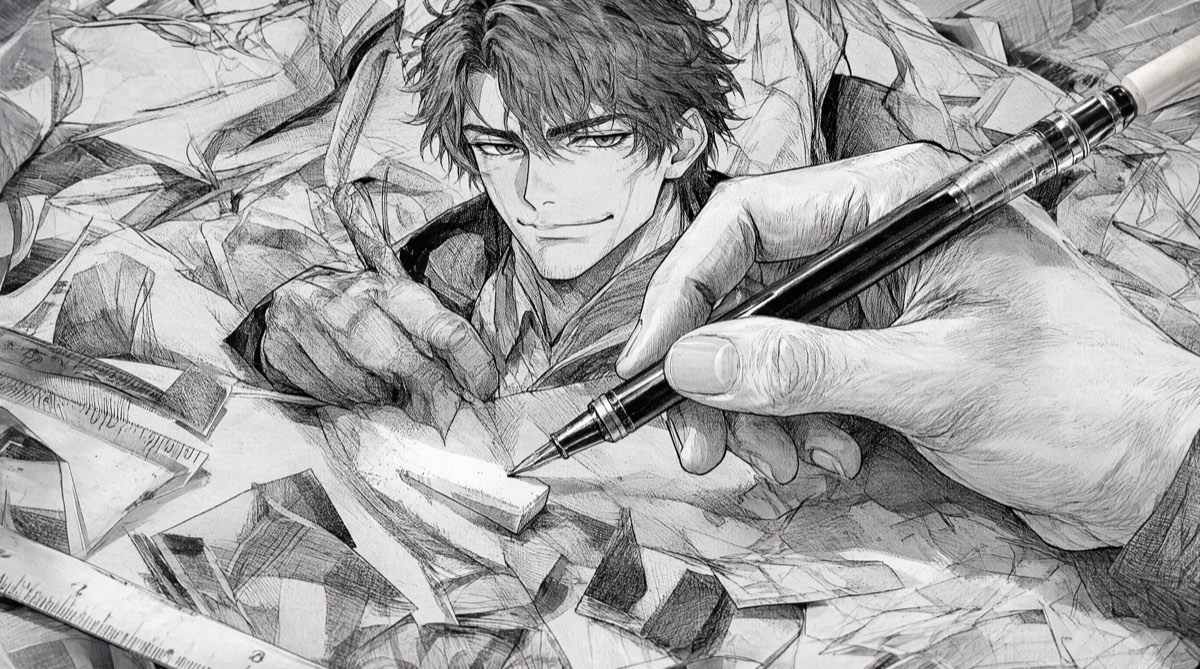
The illustrations in this article were drawn by Ai-Koma from descriptions written by the team; they depict no real person.
 Anatomy of a manga page: panels, speech bubbles, reading direction
 Shōnen, shōjo, seinen, josei: the main manga styles and how to recognise them
 Manga vocabulary: the 30 words you need to know