Ai-Koma began as a manga studio. It now draws Western comics too: six comics and bande dessinée styles sit alongside the 32 manga styles, from the quiet, painted graphic novel to the four-colour superhero comic book. The method stays the same. You write your story; the AI writes the script panel by panel, with captions and dialogue; you edit it; then each page is drawn as one finished image, lettered in English. A chapter runs from 1 to 8 pages, the story can go on for as many chapters as you like, and the bound edition turns the whole thing into one PDF with a cover.
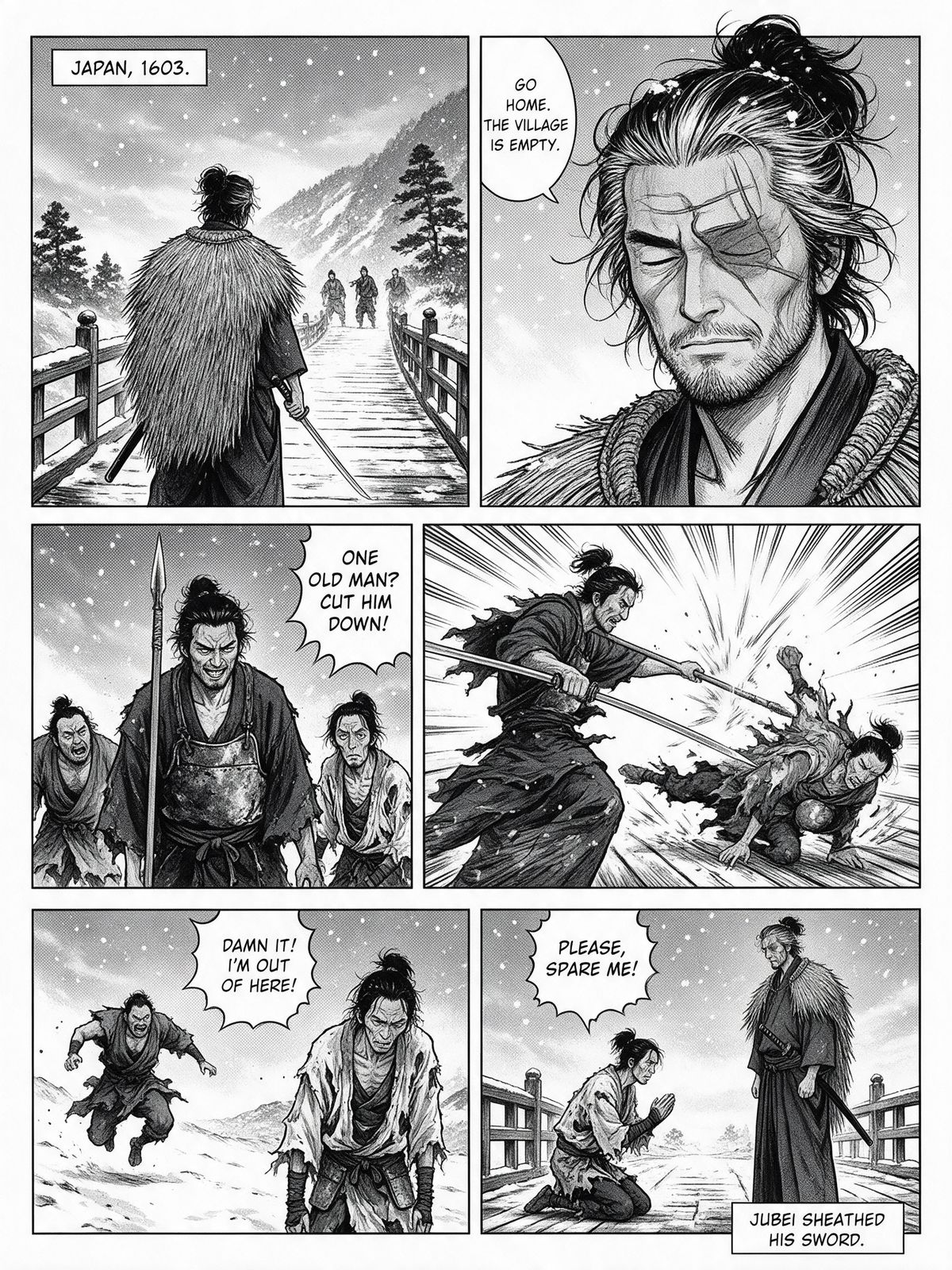
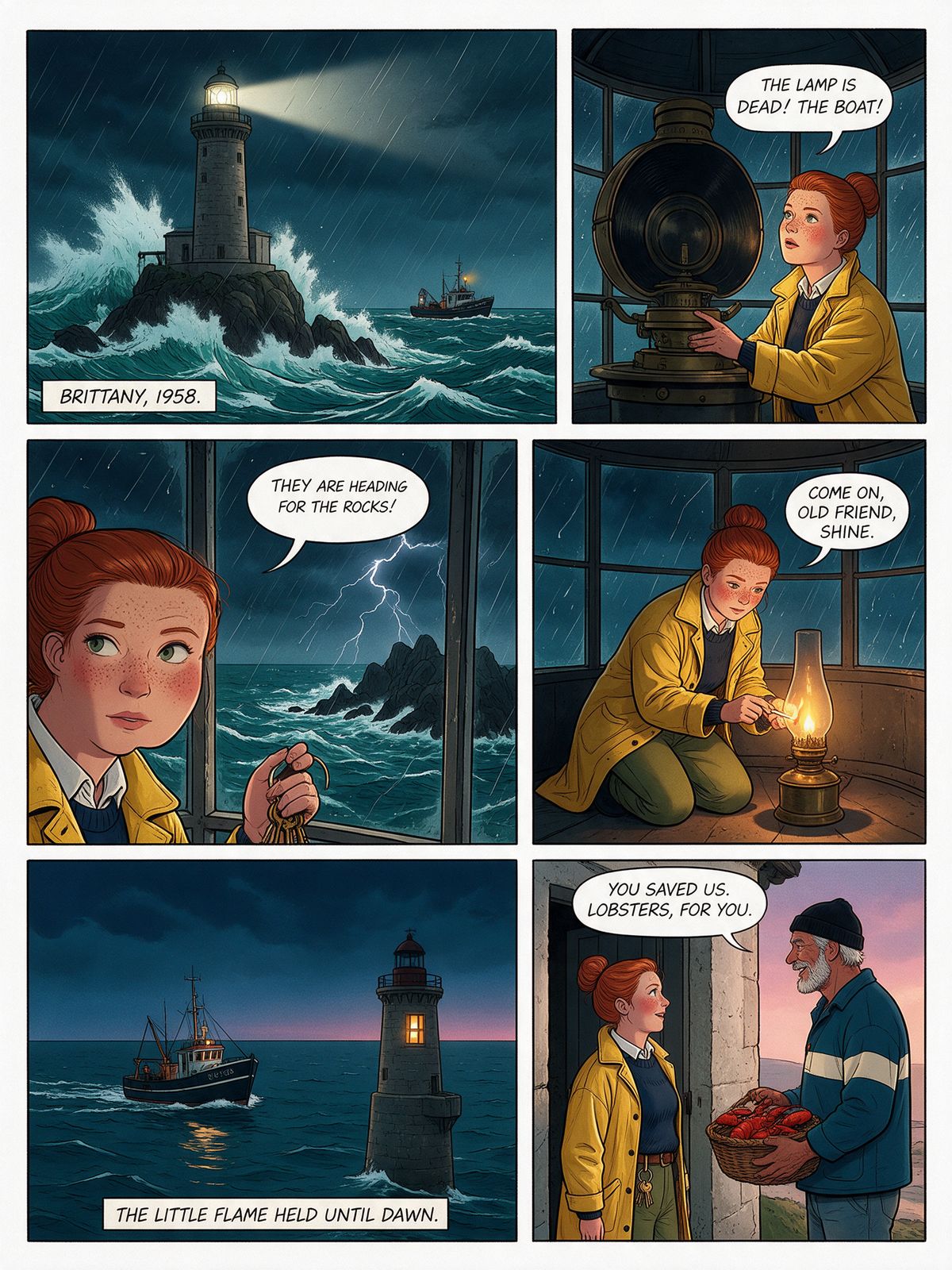
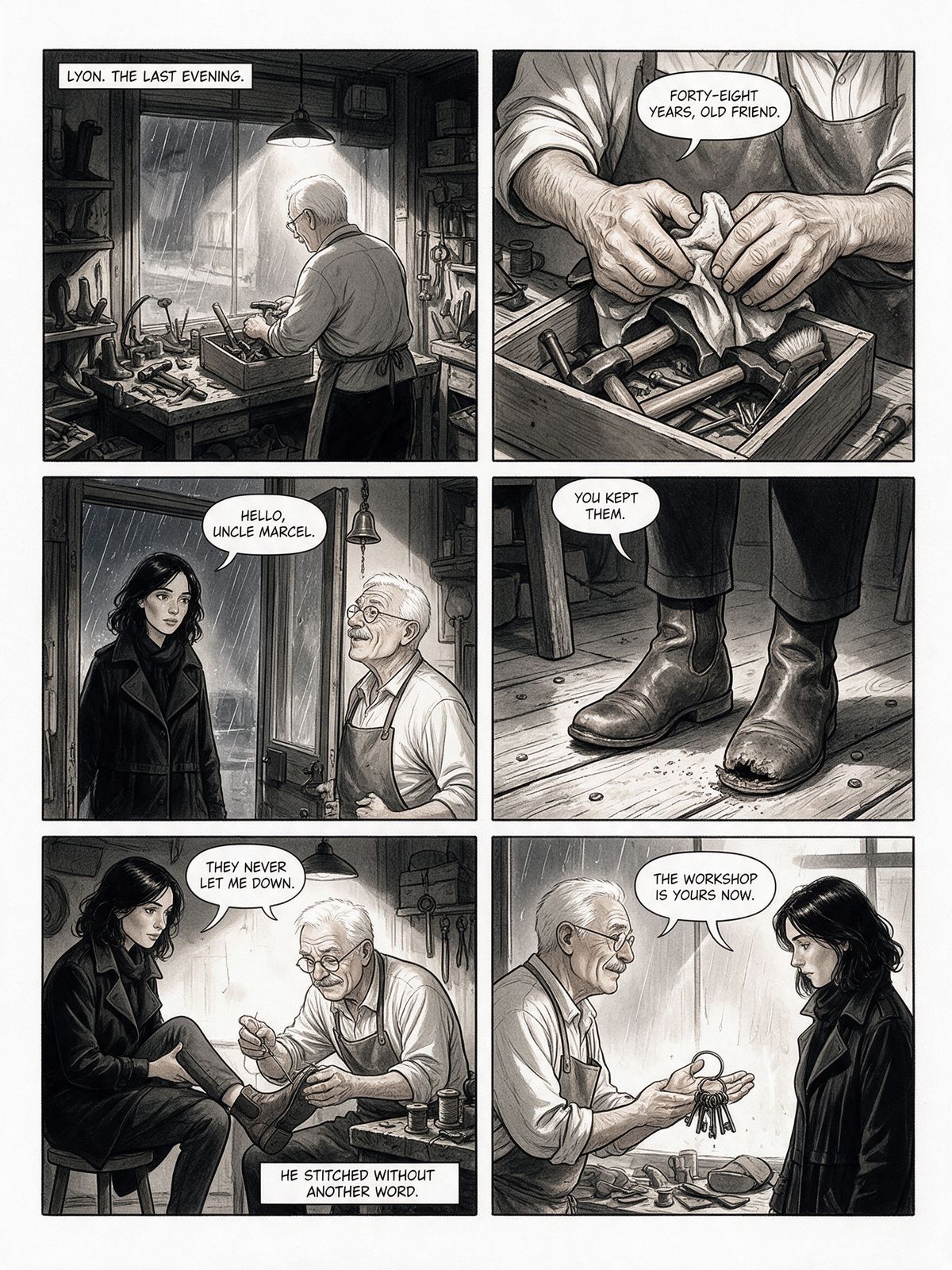
The two example pages on this page were drawn by Ai-Koma in two of these comics styles, six panels each, with no retouching, from the stories you can read in the gallery. The other four styles have no published example yet.
The six comics styles
- Graphic novel. Expressive brush ink or watercolour, a muted palette, intimate and atmospheric storytelling, naturalistic characters. For memoirs, family stories, quiet journeys, anything that lives on looks and silences.
- Superhero comics. Bold, heavy inks, dynamic foreshortening and dramatic poses, costumes and capes, a vibrant four-colour palette with halftone dots, explosive action effects.
- Franco-Belgian clear line. Clean outlines of even weight, no hatching, flat bright colours, detailed backgrounds and architecture, staging that reads at a glance: the classic European adventure album.
- Realistic adventure comic. Semi-realistic anatomy, fine inking with hatching, detailed landscapes, vehicles and costumes, wide cinematic panels, painterly colours. For westerns, historical epics and expeditions.
- Humour comic. Round, bouncy cartoon characters with big noses and expressive faces, slapstick poses, motion lines, bright flat colours. For gags and running jokes.
- 70s European sci-fi. Intricate fine linework, surreal alien landscapes and megastructures, strange creatures and spacecraft, rich psychedelic colours.
In black and white, these styles are inked with hatching and solid blacks rather than manga screentones. And when you make the bound edition, its cover is drawn as a comic album cover, not as a manga volume.
Graphic novel or comic book?
The words overlap, but they usually point to two things. A comic book is a short, often serialised issue, built for momentum: superheroes, adventure, cliffhangers. A graphic novel is a longer, self-contained story, often more personal, read like a novel. In Ai-Koma, both start from the same place, a story of a few lines; the difference comes from the style you pick and from how far you take it, one chapter or several gathered into a bound edition.
Writing a comic script that draws well
Western comics lean on captions more than manga does, and many pages end on a reveal. A few habits help the AI as much as they would help a human artist:
- Use captions for time, place and voice. “Marseille, 1962.” or a narrator’s line opens a scene in a single box. In the storyboard, each panel can carry a caption as well as a line of dialogue.
- One action per panel. “He lands, cracks the pavement and looks up” is three panels, not one.
- Short lines. Around ten words per bubble: the page breathes, and the lettering makes fewer mistakes.
- Invent your own heroes. A costume, a symbol, a power and a weakness of your own: an original character belongs to nobody else, and the character sheet keeps the costume identical on every page.
- Six panels per page by default. That is the rhythm of a comic album, and the comics styles start there. Go down to three wide panels for realistic adventure or sci-fi, when landscapes matter. The number you pick is a minimum: if the AI adds a panel to tell the scene better, the page is kept as drawn.
Three stories to start with
- Graphic novel, colour. “Lena, 42, empties her late father’s workshop in a small harbour town and finds forty years of unsent letters, all addressed to the same woman. She decides to deliver them.”
- Superhero comics, colour. “Night Courier, a hero whose only power is never being late, has twelve minutes to cross the city with a birthday cake. Two giant robots have just started fighting in the middle of his route.”
- 70s European sci-fi, colour. “A lone cartographer lands on a planet whose mountains move every night. Her map is useless by morning, until she notices that the mountains are spelling something.”
For more ideas, our list of story ideas has forty prompts that work just as well in comics styles.
From story to bound edition, in five steps
- Choose a style in the Comics and bande dessinée family, colour or black and white, 1 to 8 pages, six panels per page (or three, or four).
- Write the story. The field takes up to 12,000 characters, so a short story or a first chapter fits.
- Edit the script: each panel described, with its caption and dialogue. Nothing is drawn until you approve it.
- Let it draw: the character sheet first, then each page, three to six minutes apiece.
- Continue, then bind. Add chapters with “Continue the story”; the bound edition gathers them in one PDF with an AI-drawn cover, a contents page, numbered chapters and a back cover.
Every step is explained in detail, with writing tips, in our guide to turning a story into a manga; it applies to comics just as well. For manga styles, see the AI manga generator.
What it costs
One credit is one euro cent. A four-page comic costs 140 credits (€1.40), an eight-page chapter 240 credits (€2.40), and the bound edition 50 more. The 50 credits you get on sign-up pay for a first page. Credits come in packs at €5, €15 or €40, or with a €12 monthly subscription for 1,800 credits; they don’t expire. The full price list is on the AI comic generator page, and the gallery shows finished pages with the stories behind them.
Frequently asked questions
Can AI make a superhero comic?
Yes. Choose the Superhero comics style: bold inks, dramatic poses, costumes and capes, a four-colour palette with halftone dots. Invent your own hero rather than borrowing a famous one, and describe the costume precisely so the character sheet can keep it identical from page to page.
Can I make a Franco-Belgian bande dessinée with AI?
Yes. Three styles come from that tradition: Franco-Belgian clear line, Realistic adventure comic and Humour comic, alongside 70s European sci-fi.
What is the difference between a graphic novel and a comic book?
A comic book is usually a short, serialised issue built for momentum; a graphic novel is a longer, self-contained story, often more personal. In Ai-Koma, you choose the style that fits, and you can carry the story over several chapters, then bind them into one PDF.
How long can my graphic novel be?
Each chapter has 1 to 8 pages, and you can add as many chapters as you like, with the same characters and the same visual direction. The bound edition gathers them all in one PDF, with a cover drawn by the AI.
Are the speech bubbles lettered in English?
Yes, on the English site; in French on the French one. The lettering is drawn by the AI, so read every bubble: if a word comes out misspelt, “Fix a bubble” reletters it for free without touching the drawing, and “Redraw this page” draws the whole page again from the same text.
Can I make a graphic novel with AI for free?
Not entirely, and we would rather say so: the 50 credits you get on sign-up pay for a first page, script included. After that, a four-page comic costs €1.40.