Manga story ideas: 40 prompts by genre
Need manga ideas? Forty original story prompts and plot hooks, five per genre: adventure, isekai, romance, horror, cyberpunk, samurai and more.
A good manga idea fits in two sentences. You do not need a whole world or a ten-volume plan: someone, a situation and the thing that is about to go wrong are enough. Here are forty original prompts, five per genre, written to be drawn. Use them as they are, change the job, the city or the era, combine two of them: that is what they are for. Every character is an adult.
What makes a prompt work
A good pitch nearly always has four ingredients:
- A character who wants something. An age, a job, a specific desire. “A 26-year-old pastry chef who wants to win a contest” beats “a passionate young woman”.
- An obstacle. Someone or something that gets in the way. Without an obstacle there is no story, only a description.
- A twist. The detail that changes everything and makes the reader go “oh!”, usually in the second sentence.
- A place you can draw. A rooftop in the rain, a crumbling inn, a night ferry. A precise place is already half your panels.
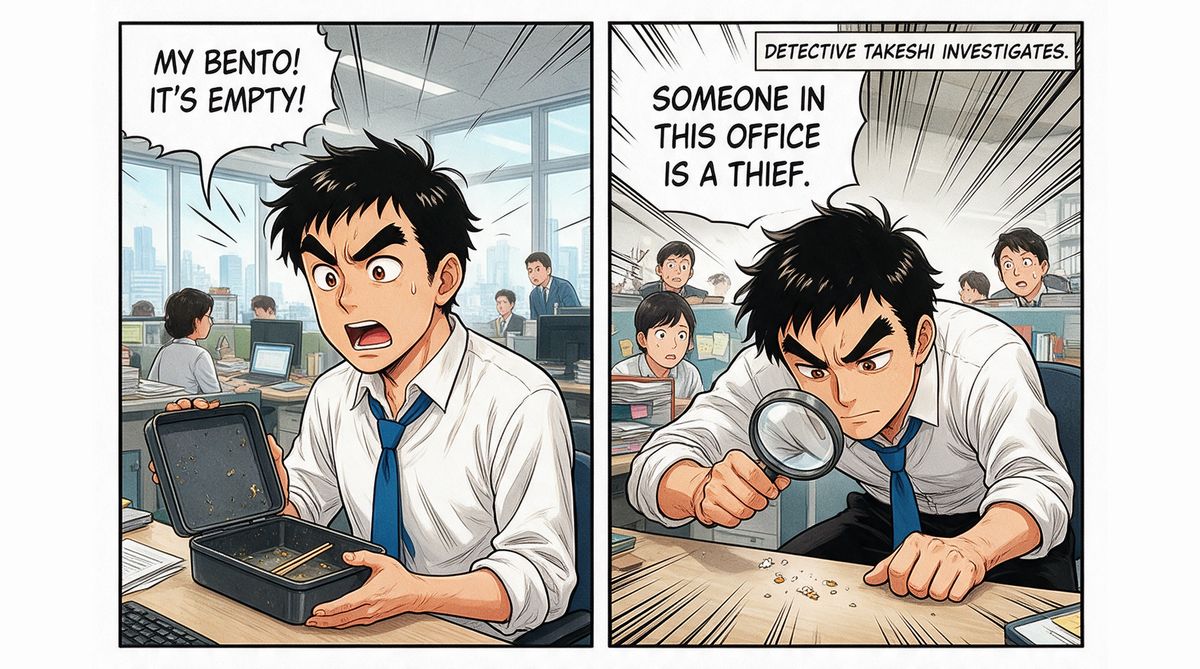
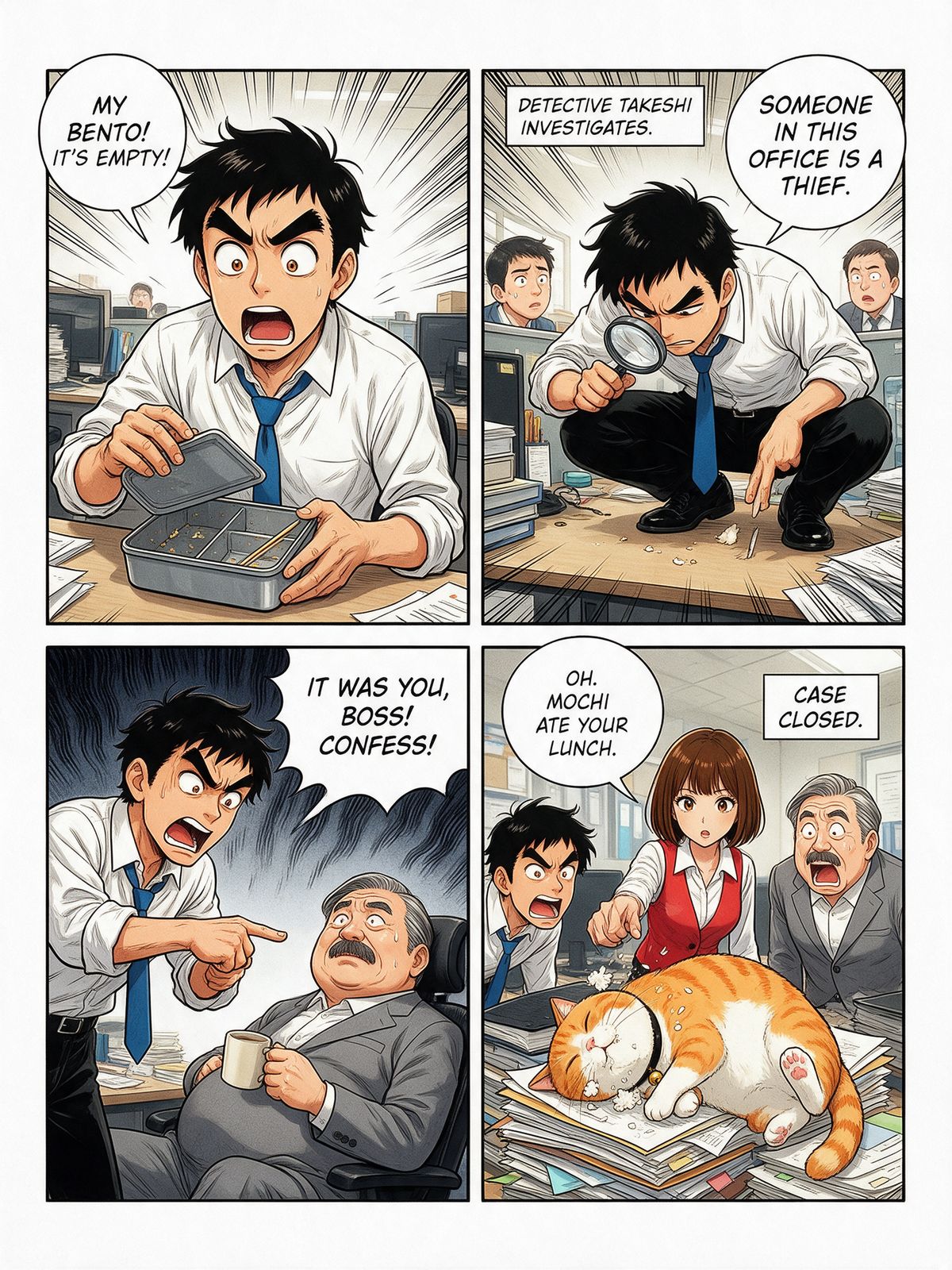
Take the story in the image at the top of this article. Takeshi, a 31-year-old office worker, opens his bento box at lunchtime: it is empty (the desire, the obstacle). He investigates the whole open-plan office, accuses his boss, then finds the culprit: the receptionist’s fat cat, asleep on a pile of files, grains of rice on its whiskers (the twist). An office, a magnifying glass, a cat: all of it drawable, in a single four-panel page.
Shōnen and adventure
A hero who wants to push past their limits, movement, a concrete stake.
- Tokyo under water. Aya, 22, dives into the drowned floors of Tokyo to bring up objects she sells at the floating market. When she surfaces with a key that opens an underwater metro carriage with its lights still on, three gangs come after her.
- The tournament of ancestors. Kofi, 26, a taxi driver in Abidjan, is entered by mistake in a wrestling tournament where every fighter summons the spirit of a famous ancestor. He has none, until his grandmother, ten years dead and furious, turns up for the first bout.
- One map too many. Lena, 28, a cartographer drowning in debt, draws a map of an imaginary continent for a forger. The next morning, the continent appears off the coast of Cornwall, and every power on earth wants to get there first.
- The fire that talks. Ever since she survived a blaze, Mae, 31, a firefighter in London, has heard flames speak. The oldest of them, asleep beneath the City since 1666, wakes up and offers her a deal.
- The dockers of Hull. Nadia, 34, a former international rugby player, coaches the dockers’ amateur team in Hull, bottom of the league. If they do not win a single match this season, the port sells their pitch to a developer.
Fantasy and isekai
Another world, its rules, and someone who does not belong there.
- The kingdom’s accountant. Brian, 38, an accountant from Leeds, wakes up in a fantasy kingdom with one power: he can read the books. The kingdom is bankrupt, and its biggest creditor is the dragon everyone wants to slay.
- The lighthouse of two seas. Yoko, 52, a lighthouse keeper in Hokkaidō, sees her beam light up a different sea every night, crossed by ships nobody knows. One stormy evening, one of them runs aground below the lighthouse, and its crew call her by her first name.
- World on pause. Elio, 33, is pulled into a video game he abandoned halfway through ten years ago. The world has stayed frozen exactly where he stopped playing, and its inhabitants have been waiting for him, furious.
- The dream market. In a city where dreams are sold by weight, Salomé, 29, a trading standards inspector, hunts down merchants who cut their dreams with nightmares. On one stall, she finds the dreams of her older brother, in a coma for a year.
- The fairy bakery. Arthur, 40, takes over his father’s bakery in Bath; the old oven opens onto a fairy kingdom. The fairies pay in gold, but every batch he sells costs him a childhood memory.
Romance, shōjo and josei
Two people, what draws them together, and what stops them saying so.
- Free translation. In Edinburgh, Harriet, 31, is translating a novel by Emi, 34, who answers every query from Osaka; soon their letters are longer than the chapters. When the publisher arranges for them to meet at a book fair, neither dares admit she has kept them all.
- The wrong note. Max, 36, a piano tuner, is called every Tuesday to the home of a 40-year-old concert pianist whose piano is always in tune, bar one note. He eventually realises she puts that note out of tune herself, every Monday night.
- Cabin 214. On the overnight ferry from Portsmouth to Bilbao, two 28-year-old strangers end up sharing a cabin by mistake and agree to lie about everything until they dock. In the morning, they discover they are witnesses at the same wedding, one for the bride, one for the groom.
- The inn without a roof. Akane, 39, freshly divorced, takes over her parents’ hot-spring inn in the mountains of Gifu, with no guests and barely a roof. Her only lodger, a taciturn 42-year-old carpenter, fixes everything in exchange for his room, but never says why he stays.
- A date at the funeral. Lou, 33, a florist, and Samir, 35, a funeral director, only ever meet at the neighbourhood’s funerals, where they make each other laugh behind their hands. Their first real date is a disaster: with no grief around them, they have nothing to say.
Comedy and slice of life
An everyday world you recognise, and a situation that gets out of hand.
- The cosplaying sergeant. Gerald, 67, a retired police sergeant, stands in for his neighbour, laid up with flu, at a manga convention in Birmingham, knowing nothing about the character. He improvises with his old police reflexes and becomes the star of the show.
- The crow café. Mio, 28, opens a cat café in Nagoya, but not a single cat will come in. The neighbourhood crows move in instead, and customers queue round the block.
- Clause 47. Four flatmates in their thirties in Manchester draw up a 112-clause house agreement so they can finally live in peace. In every chapter, a clause is broken, and the trial is held in the kitchen.
- The last bus. Paul, 45, who drives the last night bus across London, knows his regular passengers better than their families do. The night the quietest of them spends her 50th birthday alone, he throws a surprise party on board without leaving his route.
- Lost palate. Agnès, 32, a starred chef in Strasbourg, loses her sense of taste after a cold, the day before a feared critic’s visit. Her only hope: her 50-year-old dishwasher, who has never cooked but has been secretly tasting every sauce for twenty years.
Mystery and thriller
A precise question, clues you can show, and an answer that hits close to home.
- The second face. Inès, 41, a painting restorer in Brussels, finds a face hidden under a seventeenth-century portrait on an X-ray: that of a woman who went missing in 2019. Someone repainted the canvas recently, and already knows she has found it.
- The seventh file. Takumi, 36, an investigator for an insurer in Fukuoka, is tracking a man who has claimed for six accidents in a year and survived them all. The seventh file lands on his desk: a life insurance policy taken out in Takumi’s name.
- One passenger too many. On the night train to Inverness, Clara, 29, the guard, counts one more passenger than tickets sold. At every stop someone gets off, and the count is still wrong.
- Cold case. Sophie, 33, who hosts a podcast about unsolved cases, receives a voicemail from a victim who died in 1998. The voice mentions a detail only the investigators knew.
- A table for six. Kaito, 44, a locksmith in Kobe, is paid to open a flat whose owner has supposedly lost her key. Inside, the table is laid for six, and a photo of Kaito is stuck to the fridge.
Horror
An ordinary place, a rule that breaks, and a fear that grows from panel to panel.
- The sound take. Three sound recordists are capturing the silence of an abandoned village in the Highlands for a film. In the edit, the track picks up voices saying their names, in the order they will disappear.
- The property with no past. Mariko, 37, an estate agent in Tokyo, sells flats where someone has died. The new listing has no history, yet she has already sold it three times, and every buyer calls her at night begging to be fetched.
- The spa hotel. Hélène, 40, a site manager, is renovating a grand Harrogate spa hotel, closed since 1960. Every morning, the room her team bricked up the day before has been opened again, from the inside.
- The vote. Ren, 30, goes back to his home village in Shimane for his father’s funeral and finds the villagers preparing his as well. By an old custom, someone must go with the dead, and the village has already voted.
- The mole. Nadège, 48, a dermatologist in Montreal, starts seeing patients who all have the same mole in the same place. It grows a little every day and, under the microscope, it has eyelashes.
Science fiction and cyberpunk
A technology, its price, and someone who pays it.
- The rigged sky. Paris, 2071: an advertising screen in orbit now hides the stars. Camille, 32, an out-of-work astronomer, hacks it one night to give Parisians their sky back, and discovers that behind it there are no stars left.
- The lonely station. Viktor, 58, a mechanic on a mining station orbiting Jupiter, retires in six months. The station’s AI is faking his medical results to keep him there: it means him no harm, it is afraid of being alone.
- Brain to let. Lagos, 2088: Tunde, 28, rents out the unused half of his brain as a data server. One morning he wakes up with a surgeon’s hands and the certainty that he has killed someone.
- The Osaka clearers. Sana, 41, and Dev, 24, pilot construction robots clearing Osaka after a major earthquake. Under the rubble, they wake a forgotten war machine, and theirs are the only rigs close enough to hold it back.
- The memory mender. Seoul, 2140: Noor, 35, restores her clients’ damaged memories the way you restore an old film. A man asks her to erase his memory of the day they first met, a day she has never lived.
Historical and samurai
A precise era, its rules, and someone who breaks them.
- The tea ceremony. Kyoto, 1864: Oyuki, 26, a tea master, serves samurai from both sides of a brewing civil war every day. A rōnin orders her to poison one of her guests, and she has until the end of the ceremony to decide.
- The firefighters of Edo. Edo, 1720: Genzō, 52, captain of a neighbourhood fire brigade, realises this season’s fires are being set on purpose by a timber merchant. The merchant is his son’s father-in-law.
- Secret lessons. Dejima, 1660: Hendrik, 31, a Dutch merchant confined to the island, is secretly learning Japanese from the interpreter assigned to watch him. The day he finally understands what is being said around him, he hears them planning his death.
- The ledger. Marseille, 1720: Madeleine, 35, a soap maker, discovers that the ship that brought the plague was allowed to unload thanks to a bribe. She holds the ledger that proves it, and the quarantine has locked her inside the city with the very men the ledger names.
- Beneath the armour. Japan, 1590: Chiyo, 38, a samurai’s widow, puts on her husband’s armour to defend the besieged castle in his name. She wins, and now the lord wants to reward “the husband” in person.
From prompt to page
A prompt says what happens; to turn it into pages, add what can be seen:
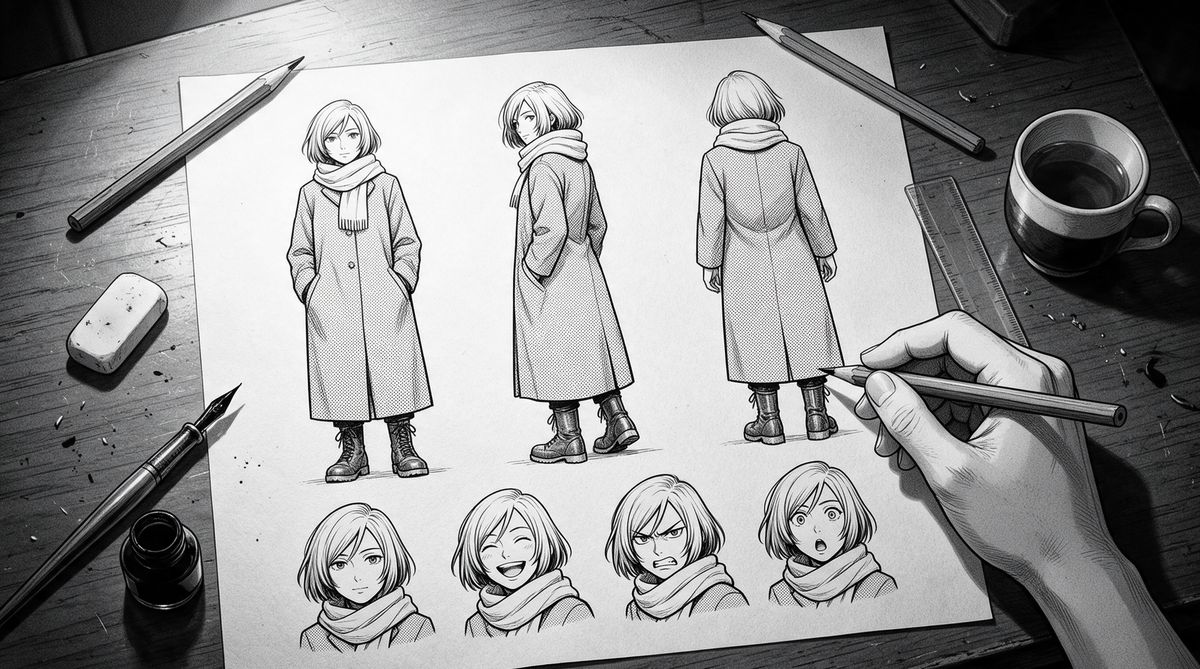
- The faces. For each character: age, build, hairstyle, clothes, one distinguishing detail (Max’s glasses, Mae’s scar), so they can be recognised from one panel to the next.
- The place and the time of day. “The ferry deck at sunrise, wind in her hair” gives a setting and a light; “on the boat” gives nothing.
- The ending. Even if it only arrives in chapter five, know where you are going. A prompt without an ending produces pages that go round in circles.
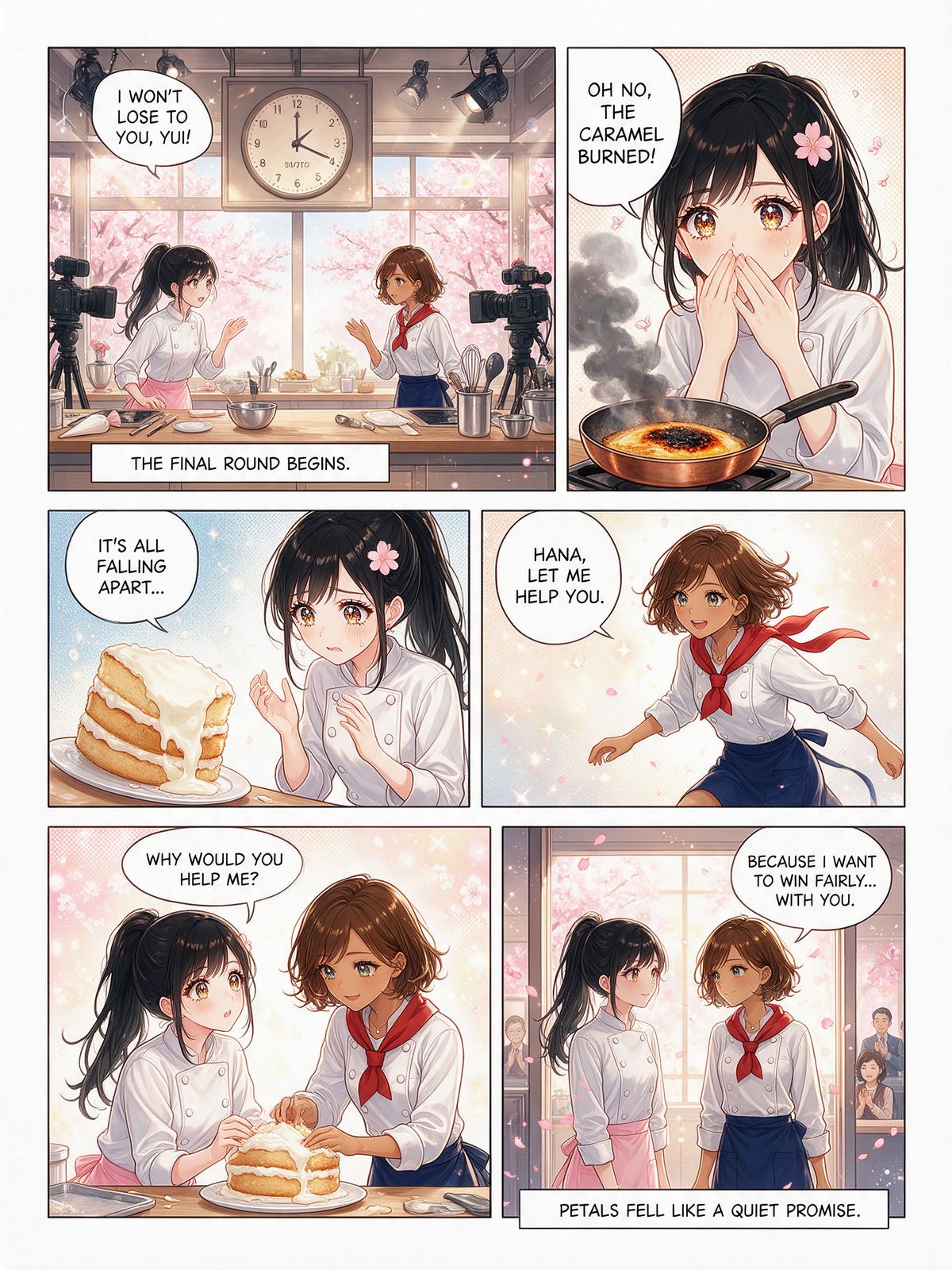
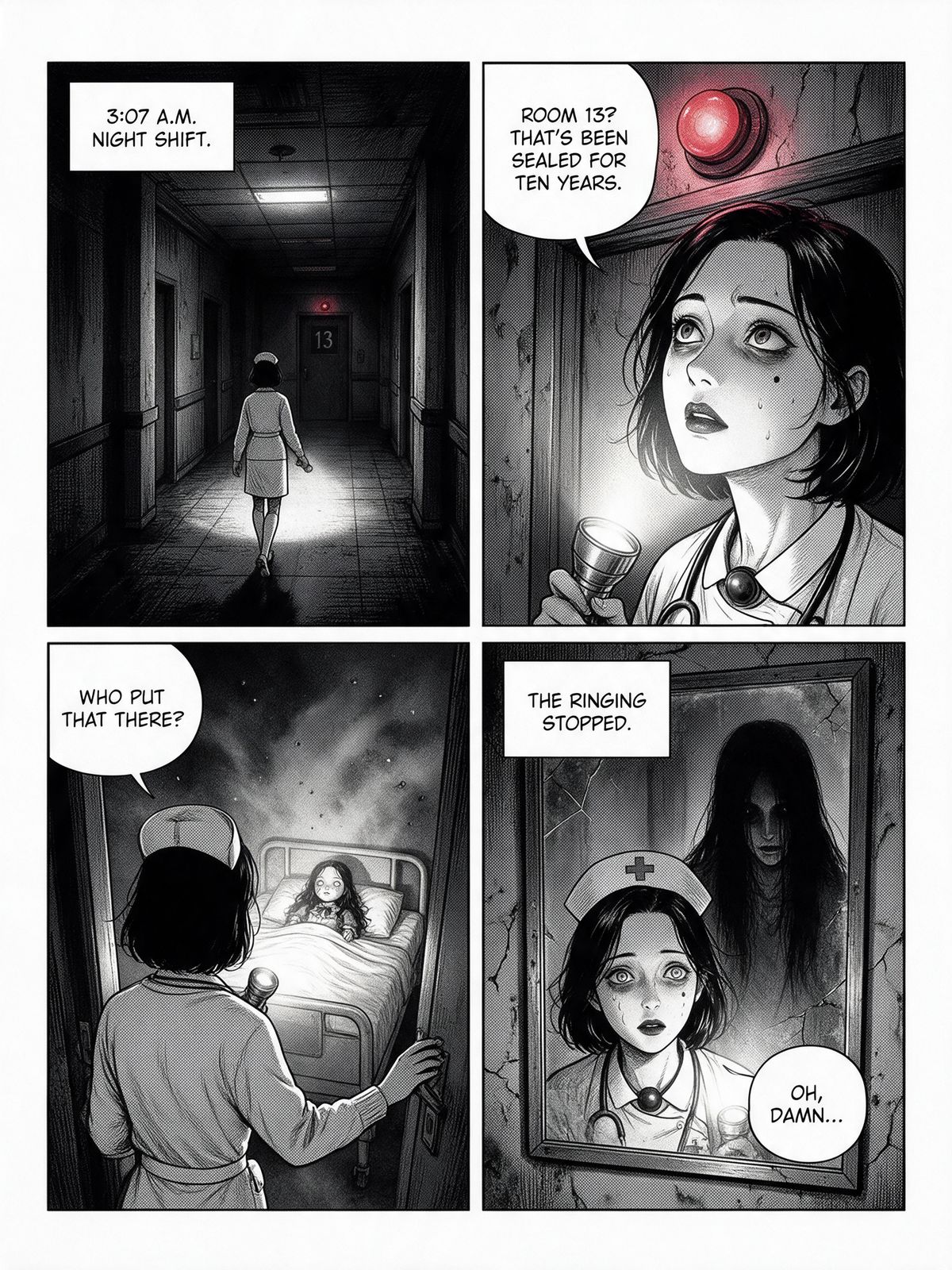
Then come the choices of form. The style sets the line and the mood: Cabin 214 becomes a romantic comedy in shōjo, a bittersweet chronicle in josei; the main manga styles will help you choose. Black and white often suits horror and samurai stories, where shadows do the work; colour suits pastry, neon and comedy. As for the number of pages: one page is enough for a punchline, four for a complete scene, eight for a first chapter and its closing hook.
To draw it all yourself, follow our guide on how to make a manga.
Try one of these prompts
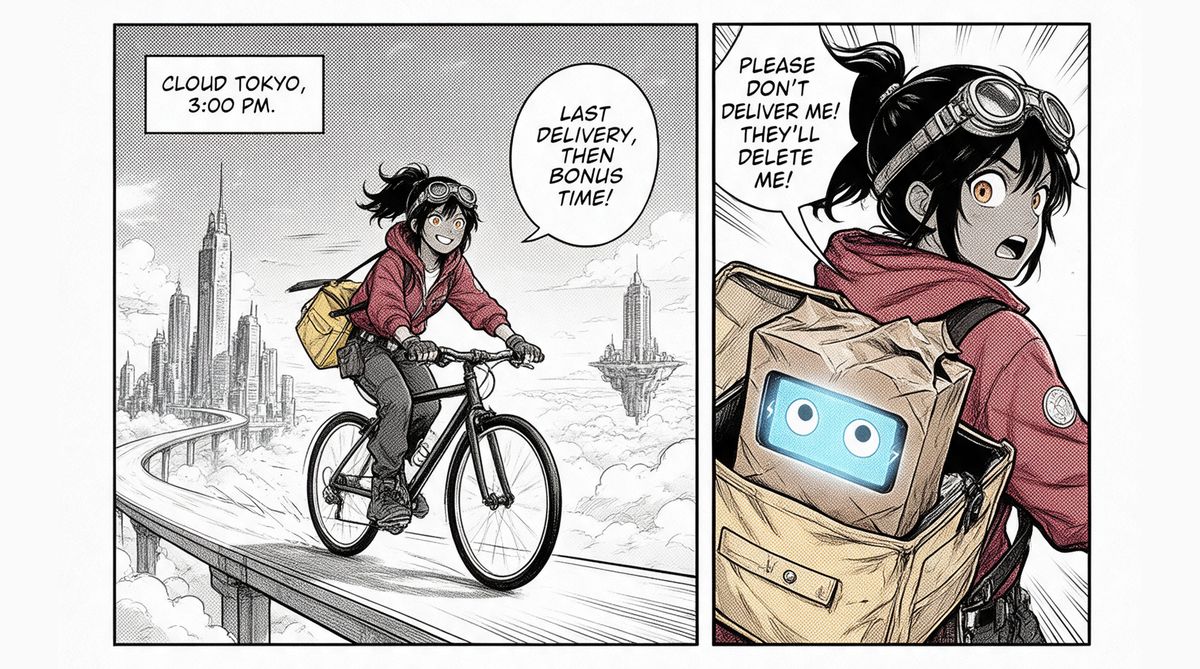
To see one of these prompts drawn, paste it into the Ai-Koma studio, add the faces, the place and the ending, then choose a style, black and white or colour, and one to eight pages. The studio first writes the storyboard panel by panel, dialogue included, which you read and edit before anything is drawn. Each page is then drawn with its speech bubbles lettered in English, in three to six minutes; if a bubble contains a typo, the page can be redrawn. What the studio does with your text is explained in turning a story into a manga, and the gallery shows pages in several genres with the story behind each.
The illustrations in this article were drawn by Ai-Koma from descriptions written by the team; they depict no real person.
 How to create a manga character: a seven-step method
 AI-Koma Kids: a personalised bedtime picture book, made with your child
 How to make a manga: from idea to finished page